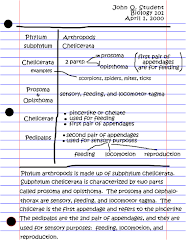
Note taking is essential for studying and learning in college
Taking notes develops a sense of listening
Lecture notes provide the clearest and best indication of what the you should study for the exam
Taking notes in class makes the student an active participant in the learning process rather than a passive listener or daydreamer.
Taking notes helps the student sort out important information
The notes taken will become a study aid, an external memory device, and an instrument to aid in review and recitation
REMEMBER THESE IMPORTANT POINTS ABOUT TAKING NOTES
Review your notes as soon as possible after class
Review the notes from the previous class meeting while you sit and wait for the class to begin
Review each week's notes at the end of the week
Studies have shown that one's recall rises immediately after learning
After about twenty-four hours, recall has diminished by about 80%
The single most effective way to prepare for a test is recitation
Hearing your own voice summarizing the material and quizzing yourself on it will greatly reinforce your mental image of the subject.
Studies have shown that about 80% of your study time should be spent in recitation rather than rereading.
Friday, July 31, 2009

TIME MANAGEMENT
One of the hardest things in making the transition from high school to college is realizing that you alone (not your parents or professors) are in charge of how your time is spent. Many times college freshmen have not learned to manage their time effectively because they have never really had the opportunity. In high school much of your time was managed for you. College offers many more choices of ways to use (and often waste) time.
You may have had all A's and B's in high school are now receiving C's and D's in college. Just because you are receiving lower grades does not mean tht you are less capable than those receiving higher grades but your study skills, including time management, may need some work.
5 STRATEGIES FOR IMPROVING TIME MANAGEMENT SKILLS
Set specific and measurable goals; both academic and personal
Create a semester calendar
Create a weekly schedule
Make a to-do list for each day of the week
Set aside time to work on each course
You may have had all A's and B's in high school are now receiving C's and D's in college. Just because you are receiving lower grades does not mean tht you are less capable than those receiving higher grades but your study skills, including time management, may need some work.
5 STRATEGIES FOR IMPROVING TIME MANAGEMENT SKILLS
Set specific and measurable goals; both academic and personal
Create a semester calendar
Create a weekly schedule
Make a to-do list for each day of the week
Set aside time to work on each course
Thursday, July 30, 2009
PREPARING FOR A MULTIPLE CHOICE EXAM
Step 1
Carefully read the test question and determine what is being asked by identifying key words.
Step 2
Make sure to read all the answer choices. There are probably a couple of obviously wrong answers you can eliminate right away.
Step 3
Extreme words such as All, Always and Never generally are not in the correct answer.
Step 4
If you see the answer choice, "None of the Above" this is usually not the correct answer. If you see the answer choice, "All of the Above" this usually is the correct answer.
Step 5
If you have two answer choices and they are direct opposites, one of them is most likely the correct answer.
Step 6
Make sure you answered the question! This seems like it would be obvious, but when people write tests they come up with some really good answer choices that are correct, they just don't answer the question being asked.
Carefully read the test question and determine what is being asked by identifying key words.
Step 2
Make sure to read all the answer choices. There are probably a couple of obviously wrong answers you can eliminate right away.
Step 3
Extreme words such as All, Always and Never generally are not in the correct answer.
Step 4
If you see the answer choice, "None of the Above" this is usually not the correct answer. If you see the answer choice, "All of the Above" this usually is the correct answer.
Step 5
If you have two answer choices and they are direct opposites, one of them is most likely the correct answer.
Step 6
Make sure you answered the question! This seems like it would be obvious, but when people write tests they come up with some really good answer choices that are correct, they just don't answer the question being asked.
READING SKILLS
College classes require more reading than most students are used to. Learn the 5 most important strategies to make the time you do have to read more efficient.
Step 1
UNDERSTAND THE PURPOSE
There are many different types of reading, each with a different purpose.-scanning – preview questions and answer choices -idea reading – very quick, looking only for the most important words -exploratory reading – more detailed -study reading – maximum understanding of ideas -critical reading – separating fact and opinion / making judgments about -what the author wants you to believe -analytical reading – used when studying math or science / requires deep concentration
Step 2
LOOK UP VOCABULARY THAT MAY BE NEW TO YOU
This may take some time, but if you don't then you might miss the message.
Step 3
WRITE IT OUT
If you are reading information that may be on an exam later, write out potential questions and answers. That way you will have something to go back to later when you are studying for the exam.
Step 4
REACT IN SOME WAY TO THE MESSAGE OF WHATEVER YOU ARE READING
Whether you love it, hate it, agree or disagree reacting to what you are reading will help you remember it later.
Step 5
DON'T BE AFRAID TO MARK IN YOUR BOOK
Highlight, underline, or circle (or whatever else you feel comfortable doing). When you are studying for the test later on you don't want to have to read the whole book over again. Marking in your books will save time later.
Step 1
UNDERSTAND THE PURPOSE
There are many different types of reading, each with a different purpose.-scanning – preview questions and answer choices -idea reading – very quick, looking only for the most important words -exploratory reading – more detailed -study reading – maximum understanding of ideas -critical reading – separating fact and opinion / making judgments about -what the author wants you to believe -analytical reading – used when studying math or science / requires deep concentration
Step 2
LOOK UP VOCABULARY THAT MAY BE NEW TO YOU
This may take some time, but if you don't then you might miss the message.
Step 3
WRITE IT OUT
If you are reading information that may be on an exam later, write out potential questions and answers. That way you will have something to go back to later when you are studying for the exam.
Step 4
REACT IN SOME WAY TO THE MESSAGE OF WHATEVER YOU ARE READING
Whether you love it, hate it, agree or disagree reacting to what you are reading will help you remember it later.
Step 5
DON'T BE AFRAID TO MARK IN YOUR BOOK
Highlight, underline, or circle (or whatever else you feel comfortable doing). When you are studying for the test later on you don't want to have to read the whole book over again. Marking in your books will save time later.
STUDY SKILLS
If you are a freshmen in college, chances are you don't quite know what to expect when it comes to how much time you will need to study. Follow these 4 steps and you will develop study habits that will be with you for the next 4 years and make it to graduation
Step 1
DON'T UNDERESTIMATE HOW MUCH TIME YOU WILL NEED TO STUDY
When you were in high school you probably spent a lot more time in class than you did studying at home. College is the complete opposite. On average, students should expect to spend two to three hours outside of class for every hour spent in class. This means for every 3-unit class a student should expect to spend six to nine hours per week studying outside of class.
Step 2
GET INVOLVED IN A STUDY GROUP
Being in a study group is helpful because a group can always remember more than one person. It's usually most helpful to review notes right after class. Studies show that recall is best immediately after learning.
Step 3
KEEP A SEMESTER CALENDAR AND PLAN YOUR STUDY TIME
There are plenty of other things to do in college other than study. Set aside time to study for each class, if you don't you will always end up doing something else.
Step 4
USE YOUR CAMPUS RESOURCES
Don't be afraid to ask for help. Most college campuses have a learning center with free tutoring for just about every class they offer.
Subscribe to:
Posts (Atom)